Matières
Niveaux
 100%

 100%100%100%100%
 100%
 100%
 100%
 100%

| Oral evaluation | Written evaluation | |
| Evaluation type | Discussion | Written production: opinion piece |
| Preparation | Read preparation booklet | Discussion evaluation previously done in May |
| Completed 1 week before evaluation time | ||
| Evaluation structure | 15-minute discussion | 2 hours allowed |
| Group discussion: 4 students | 225-word opinion piece for a web magazine | |
| Individual student results | 5-paragraph essay: • Introduction (1 para.) • Body (3 paras.) • Conclusion (1 para.) | |
| Evaluation time | Mid-End of May | Beginning of June |
| Oral evaluation (C1) | Written evaluation (C3) |
|---|---|
Evaluation type | |
| Discussion | Written production: opinion piece |
Preparation | |
| Read preparation booklet | Discussion evaluation previously done in May |
| Completed 1 week before evaluation time | |
Evaluation structure | |
| 15-minute discussion | 2 hours allowed |
| Group discussion: 4 students | 225-word opinion piece for a web magazine |
| Individual student results | Classic 5-paragraph essay structure including: → 1-paragraph introduction → 3-paragraph body → 1-paragraph conclusion |
Evaluation time | |
| Mid-End of May | Beginning of June |
Note that C2 - Reinvests Understanding of Texts is not evaluated in the Ministry of Education Final Exam. English teachers prepare local C2 evaluations depending on the different texts (videos, plays, poems, short stories, etc.) and/or books/novels read throughout the year.
| Material | Oral Evaluation (C1) | Written Evaluation (3) |
| Electronic devices* | X | X |
| Preparation Booklet | ✔ | ✔ |
| Published Bilingual Dictionary | ✔ | ✔ |
| Published Synonyms Dictionary | X | ✔ |
| Published Grammar Resource (must not include any text or part of text that could be used verbatim or as a model) | X | ✔ |
| Home-made resources (notes, grammar prepared by a tutor/by the school, personalized documents) | X | X |
| Any photocopied documents | X | X |
| Any exercise book or resource document to help with text creation | X | X |
*Any adaptation measures linked to an Intervention Plan must be verified and arranged with your school/teacher prior to the evaluations.
| Noun-related 01 | |
| singular (noun) | Only 1. (one cat, a child) |
| plural (noun) | More than 1. (2 cats, many children) |
| common noun | Name general people, places or things. (a doctor, a city, |
| proper noun | Name specific people, places or things. (example and stuff) |
| countable nouns | Nouns we can count using numbers. (example and stuff) |
| uncountable nouns | Nouns we cannot count with numbers. (example and stuff) |
| Noun-related 02 | |
| singular (noun) | Only 1. (Ex: one cat, a child) |
| plural (noun) | More than 1. (Ex: 2 cats, many children) |
| common noun | Name general people, places or things. (Ex: a doctor, a city, |
| proper noun | Name specific people, places or things. (Ex: example and stuff) |
| countable nouns | Nouns we can count using numbers. (Ex: example and stuff) |
| uncountable nouns | Nouns we cannot count with numbers. (Ex: example and stuff) |
| Description | Definition | |
| mammal | An animal with body hair or fur, that is warm-blooded and that produces milk to feed its babies. | Cats, elephants, zebras, whales and bears |
| reptile | A cold-blooded animal that has dry, scaly skin and lays eggs. | Lizards, crocodiles, turtles and snakes |
| amphibian | A cold-blooded animal that lives part of its life in water and on land, that lays eggs. | Frogs, toads, salamanders, axolotls and newts |
| crustacean | An animal that lives mostly in water and has a hard outer shell | Crabs, lobsters, shrimps and krill |
| feline | Animals of the cat family. | Domestic cats, lions, tigers, cheetahs and leopards |
| canine | Animals of the dog family. | Domestic dogs, wolves, foxes and jackals |
| warm-blooded | Animals that maintain their body temperature by creating heat. | Mammals (including humans) and birds |
| cold-blooded | Animals with changing body temperature that cannot generate heat. | Reptiles, fish and amphibians |
| biped (noun) bipedal (adjective) | That walks on 2 legs. | Humans, birds and kangaroos |
| four-legged quadruped | That walks on 4 legs. | Cats, dogs, horses, elephants and crocodiles |
| vertebrate | An animal that has a backbone. | Mammals, reptiles, birds, amphibians and fish |
| invertebrate | An animal without a backbone. | Crustaceans, octopuses, starfish, jelly fish and squid |
| herbivore | Animals that feed on plants such as grass, leaves, fruits, flowers and bark. | Cows, pandas, koalas, rabbits and elephants |
| carnivore | Animals that feed on meat. | Cats, dolphins, tigers, crocodiles and eagles |
| omnivore | Animals that feed both on plants and meat. | Bears, raccoons, monkeys, pigs and crows |
| insectivore | Animals that feed on insects or bugs. | Chameleons, marmosets, frogs, robins and bats |
| predator | Animals that hunt, catch and eat other animals. | Cats, leopards, polar bears, eagles and orcas |
| prey | Animals that are hunted by predators. | Deer, antelopes, chicken, smaller fish species and small reptiles |
| domestic domesticated | Animals that have been tamed and kept by humans as pets, for work or as a resource. | Cats, dogs, horses, sheep and goats |
| wild | Animals that live in their natural environment. | Wolves, deer, lions, elephants and ostriches |
| nocturnal | Animals that are active at night. | Bats, raccoons, owls, boas and wombats |
| solitary | Animals that live by themselves. | Polar bears, moose, porcupines, tigers and platypuses |
| territorial | Animals that protect a specific territory from other animals. | Lions, wolves, red squirrels, peacocks and hippopotamuses |
| venomous | Animals that can produce and inject harmful toxins (venoms). | Box jellyfish, stonefish, platypuses, vipers and stingrays |
| horned | Animals that have horns. | Buffalos, antelopes, rhinoceroses and bison |
| bearded | Animals that have a growth of hair, feathers, on their chin or throat. | Bearded dragons, goats, orangutans and emperor tamarins |
| woolly | Animals covered in thick curly hair (wool). | Sheep, alpacas and llamas |
| webbed feet | Feet with skin connecting toes together, serving as natural flippers. | Ducks, frogs, penguins, beavers and otters |
| wingspan | The distance from the tip of one wing to the tip of the other wing when they are spread wide open. | Sparrow wingspan: 18-25 cm Albatross wingspan: 3.5-3.5 m |
| Description | Definition | Examples |
| mammal | An animal with body hair or fur, that is warm-blooded and that produces milk to feed its babies. | • cats • elephants • whales |
| reptile | A cold-blooded animal that has dry, scaly skin and lays eggs. | • lizards • turtles • snakes |
| amphibian | A cold-blooded animal that lives part of its life in water and on land, that lays eggs. | • frogs • salamanders • axolotls |
| crustacean | An animal that lives mostly in water and has a hard outer shell | • crabs • lobsters • shrimps |
| feline | Animals of the cat family. | • domestic cats • lions • tigers |
| canine | Animals of the dog family. | • domestic dogs • wolves • foxes |
| warm-blooded | Animals that maintain their body temperature by creating heat. | • mammals (including humans) • birds |
| cold-blooded | Animals with changing body temperature that cannot generate heat. | • reptiles • fish • amphibians |
| biped (noun) bipedal (adjective) | That walks on 2 legs. | • humans • birds • kangaroos |
| four-legged quadruped | That walks on 4 legs. | • cats • horses • crocodiles |
| vertebrate | An animal that has a backbone. | • mammals • birds • fish |
| invertebrate | An animal without a backbone. | • crustaceans • octopuses • jelly fish |
| herbivore | Animals that feed on plants such as grass, leaves, fruits, flowers and bark. | • cows • pandas • rabbits |
| carnivore | Animals that feed on meat. | • cats • dolphins • eagles |
| omnivore | Animals that feed both on plants and meat. | • bears • raccoons • pigs |
| insectivore | Animals that feed on insects or bugs. | • chameleons • frogs • bats |
| predator | Animals that hunt, catch and eat other animals. | • cats • polar bears • orcas |
| prey | Animals that are hunted by predators. | • deer • chicken • smaller fish species |
| domestic domesticated | Animals that have been tamed and kept by humans as pets, for work or as a resource. | • cats • dogs • horses |
| wild | Animals that live in their natural environment. | • wolves • deer • elephants |
| nocturnal | Animals that are active at night. | • bats • raccoons • owls |
| solitary | Animals that live by themselves. | • polar bears • moose • tigers |
| territorial | Animals that protect a specific territory from other animals. | • lions • wolves • red squirrels |
| venomous | Animals that can produce and inject harmful toxins (venoms). | • box jellyfish • vipers • stingrays |
| horned | Animals that have horns. | • antelopes • rhinoceroses • bison |
| bearded | Animals that have a growth of hair, feathers, on their chin or throat. | • bearded dragons • goats • orangutans |
| woolly | Animals covered in thick curly hair (wool). | • sheep • alpacas • llamas |
| webbed feet | Feet with skin connecting toes together, serving as natural flippers. | • ducks • frogs • beavers |
| wingspan | The distance from the tip of one wing to the tip of the other wing when they are spread wide open. | Sparrow wingspan: 18-25 cm Albatross wingspan: 3.5-3.5 m |
Height & Body Build
Age
Hair
Face
Characterizing Features
Exercise – Appearance & Description Vocabulary
Appearance & Description Vocabulary at a Glance
Advanced
Height & Body Build
Age
Hair
Face
Characterizing Features
Exercise – Appearance & Description Vocabulary
Appearance & Description Vocabulary at a Glance
Advanced
Height & Body Build
Age
Hair
Face
Characterizing Features
Exercise – Appearance & Description Vocabulary
Appearance & Description Vocabulary at a Glance
Advanced
Artificial Intelligence (AI) | Generative Artificial Intelligence (GenAI) |
|---|---|
AI is a technology that allows machines to analyze information, learn from data and make decisions, and perform tasks normally done by humans. | Generative AI is a relatively new subcategory of AI that specializes in generating content (images, music, text, etc.) often imitating human style. This technology is used by applications like ChatGPT, Gemini, Claude, Midjourney, and DALL-E. Students using generative AI is leading to questions about plagiarism at school. |
| Table test | border | none |
| Table test | border | solid |
| Table test | border | dotted |
| Table test | border | dashed |
| Table test | border | groove |
| Table test | border | ridge |
| Table test | border | inset |
| Table test | border | outset |
| Table test | border | none |
| Table test | border | solid |
| Table test | border | dotted |
| Table test | border | dashed |
| Table test | border | groove |
| Table test | border | ridge |
| Table test | border | inset |
| Table test | border | outset |
 | Daily Action Words |
 | Movement Action Words |
 | Communication Action Words |
 | Senses Action Words |
 | Mind Action Words |
 | Using your Hands Action Words |
 | Action Words at a Glance |
 | Exercise – Action Words |
 | Action Words – Advanced Vocabulary |
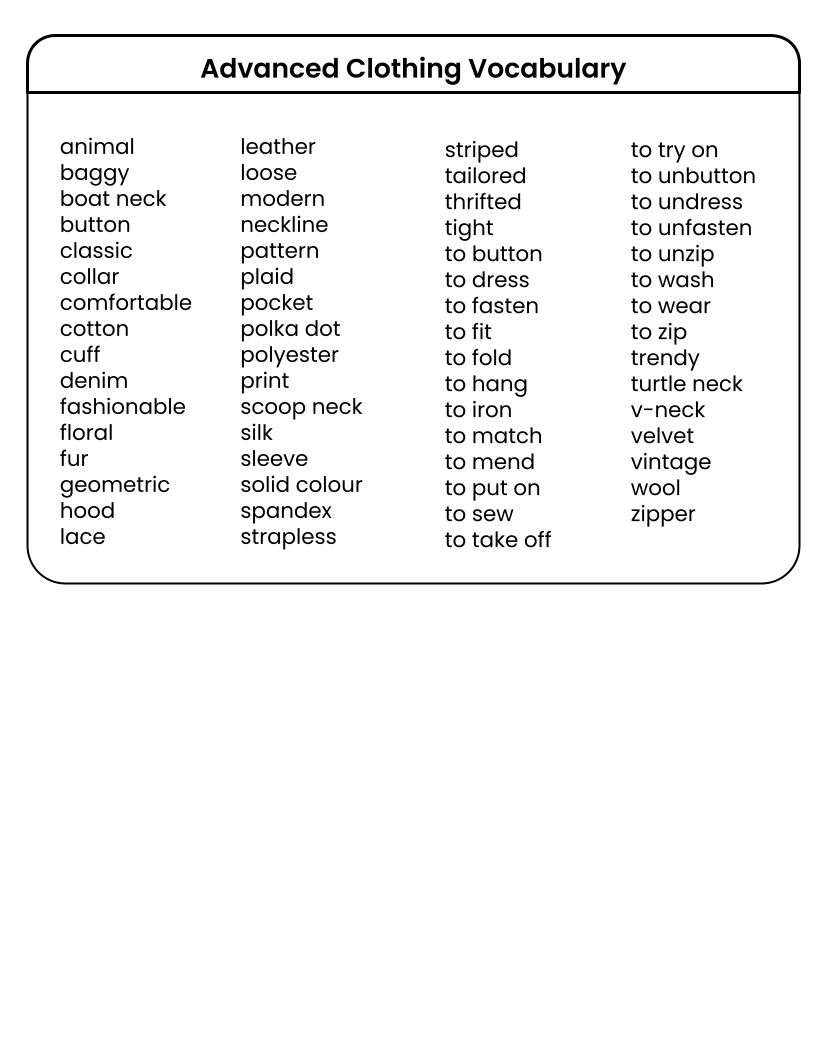
| Basic Clothing Vocabulary | Advanced Clothing Vocabulary |
| ackpack bandana barrette bathing suit bathrobe belt bikini blazer blouse boots bow-tie boxer shorts bra bracelet cap clothes coat dress dress shirt earmuffs earring(s) flip-flops glasses gloves gown hair clip handbag hat high heels hoodie jacket jeans leggings mittens neck tie necklace overalls panties pants pantyhose parka purse pyjamas raincoat ring running shoes sandals scarf scrunchie shirt shoes shorts skirt slippers sneakers socks suit sunglasses suspenders sweater sweatpants sweatshirt swimming trunks swimsuit t-shirt tie tights trousers tuque tuxedo umbrella underwear wallet watch wedding dress windbreaker winter coat wool cap yoga pants | animal baggy boat neck button classic collar comfortable cotton cuff denim fashionable floral fur geometric hood lace leather loose modern neckline pattern plaid polka dot polyester scoop neck silk sleeve solid colour spandex strapless striped tailored thrifted tight to button to dress to fasten to fit to fold to hang to iron to match to mend to put on to sew to take off to try on to unbutton to undress to unfasten to unzip to wash to wear to zip trendy turtle neck v-neck velvet vintage wool zipper |
| Parenthetical citations | Narrative citations | |
| Used when | Quoting or paraphrasing. | The author's name is part of the sentence. |
| format | (Author name, date) | Author name (date) |
| example | Don't Panic (Adams, 1979) | When Adams "Don't Panic."(1979) |
| Type of reference made | Format to use |
| Referencing an idea | (Author, date) |
| Referencing an entire book | |
| Paraphrasing without directly quoting | |
| Directly quoting | (Author, date, page number) |
| Borrowing from |
| People | Appearance & Description Body Parts Emotions & Feelings Health & Well-Being Family & Relatives Clothing People You Know Jobs & Occupations Daily Activities & Routines Action Words (Verbs) Age Groups |
| People | Appearance & Description Body Parts Emotions & Feelings Health & Well-Being Family & Relatives Clothing People You Know Jobs & Occupations Daily Activities & Routines Action Words (Verbs) Age Groups |
| People |
|
(code1+mods-720x1280)
(code2)
(code3)
(code1 + mods: 450-800)
(code4 Mods from Claude)
(code4 Mods from Claude + me)
test 001
embed code:
Evaluation type:
Discussion
Preparation:
Read preparation booklet
Completed 1 week before evaluation time
Evaluation structure:
15-minute discussion
Group discussion: 4 students
Individual student results
Evaluation time:
Mid-End of May
Evaluation type:
Written production: opinion piece
Preparation:
Written production: opinion piece
Evaluation structure:
2 hours allowed
225-word opinion piece for a web magazine
5-paragraph essay:
• Introduction (1 para.)
• Body (3 paras.)
• Conclusion (1 para.)
Evaluation time:
Mid-End of May
| Oral evaluation | Written evaluation | |
| Evaluation type | Discussion | Written production: opinion piece |
| Preparation | Read preparation booklet | Discussion evaluation previously done in May |
| Completed 1 week before evaluation time | ||
| Evaluation structure | 15-minute discussion | 2 hours allowed |
| Group discussion: 4 students | 225-word opinion piece for a web magazine | |
| Individual student results | 5-paragraph essay: • Introduction (1 para.) • Body (3 paras.) • Conclusion (1 para.) | |
| Evaluation time | Mid-End of May | Beginning of June |

The final Core Secondary 5 English as a Second Language Ministry Exam evaluates 2 competencies:
These are 2 distinct evaluations.
| Oral evaluation (C1) | Written evaluation (C3) |
|---|---|
Evaluation type | |
| Discussion | Written production: opinion piece |
Preparation | |
| Read preparation booklet | Discussion evaluation previously done in May |
| Completed 1 week before evaluation time | |
Evaluation structure | |
| 15-minute discussion | 2 hours allowed |
| Group discussion: 4 students | 225-word opinion piece for a web magazine |
| Individual student results | Classic 5-paragraph essay structure including: → 1-paragraph introduction → 3-paragraph body → 1-paragraph conclusion |
Evaluation time | |
| Mid-End of May | Beginning of June |
Note that C2 - Reinvests Understanding of Texts is not evaluated in the Ministry of Education Final Exam. English teachers prepare local C2 evaluations depending on the different texts (videos, plays, poems, short stories, etc.) and/or books/novels read throughout the year.
| Material | Oral Evaluation (C1) | Written Evaluation (3) |
| Electronic devices* | X | X |
| Preparation Booklet | ✔ | ✔ |
| Published Bilingual Dictionary | ✔ | ✔ |
| Published Synonyms Dictionary | X | ✔ |
| Published Grammar Resource (must not include any text or part of text that could be used verbatim or as a model) | X | ✔ |
| Home-made resources (notes, grammar prepared by a tutor/by the school, personalized documents) | X | X |
| Any photocopied documents | X | X |
| Any exercise book or resource document to help with text creation | X | X |
*Any adaptation measures linked to an Intervention Plan must be verified and arranged with your school/teacher prior to the evaluations.
| Noun-related 01 | |
| singular (noun) | Only 1. (one cat, a child) |
| plural (noun) | More than 1. (2 cats, many children) |
| common noun | Name general people, places or things. (a doctor, a city, |
| proper noun | Name specific people, places or things. (example and stuff) |
| countable nouns | Nouns we can count using numbers. (example and stuff) |
| uncountable nouns | Nouns we cannot count with numbers. (example and stuff) |
| Noun-related 02 | |
| singular (noun) | Only 1. (Ex: one cat, a child) |
| plural (noun) | More than 1. (Ex: 2 cats, many children) |
| common noun | Name general people, places or things. (Ex: a doctor, a city, |
| proper noun | Name specific people, places or things. (Ex: example and stuff) |
| countable nouns | Nouns we can count using numbers. (Ex: example and stuff) |
| uncountable nouns | Nouns we cannot count with numbers. (Ex: example and stuff) |
singular (noun): Only 1.
(one cat, a child)
plural (noun): More than 1.
(2 cats, many children)
common noun: Name general people, places or things.
(example and stuff)
proper noun: Nouns we can count using numbers.
(example and stuff)
countable nouns: Nouns we can count using numbers.
(example and stuff)
uncountable nouns: Nouns we cannot count with numbers.
(example and stuff)
singular (noun)
Only 1. (Ex: one cat, a child)
plural (noun)
More than 1. (Ex: 2 cats, many children)
common noun
Name general people, places or things. (Ex: example and stuff)
proper noun
Nouns we can count using numbers. (Ex: example and stuff)
countable nouns
Nouns we can count using numbers. (Ex: example and stuff)
uncountable nouns
Nouns we cannot count with numbers. (Ex: example and stuff)
| Description | Definition | |
| mammal | An animal with body hair or fur, that is warm-blooded and that produces milk to feed its babies. | Cats, elephants, zebras, whales and bears |
| reptile | A cold-blooded animal that has dry, scaly skin and lays eggs. | Lizards, crocodiles, turtles and snakes |
| amphibian | A cold-blooded animal that lives part of its life in water and on land, that lays eggs. | Frogs, toads, salamanders, axolotls and newts |
| crustacean | An animal that lives mostly in water and has a hard outer shell | Crabs, lobsters, shrimps and krill |
| feline | Animals of the cat family. | Domestic cats, lions, tigers, cheetahs and leopards |
| canine | Animals of the dog family. | Domestic dogs, wolves, foxes and jackals |
| warm-blooded | Animals that maintain their body temperature by creating heat. | Mammals (including humans) and birds |
| cold-blooded | Animals with changing body temperature that cannot generate heat. | Reptiles, fish and amphibians |
| biped (noun) bipedal (adjective) | That walks on 2 legs. | Humans, birds and kangaroos |
| four-legged quadruped | That walks on 4 legs. | Cats, dogs, horses, elephants and crocodiles |
| vertebrate | An animal that has a backbone. | Mammals, reptiles, birds, amphibians and fish |
| invertebrate | An animal without a backbone. | Crustaceans, octopuses, starfish, jelly fish and squid |
| herbivore | Animals that feed on plants such as grass, leaves, fruits, flowers and bark. | Cows, pandas, koalas, rabbits and elephants |
| carnivore | Animals that feed on meat. | Cats, dolphins, tigers, crocodiles and eagles |
| omnivore | Animals that feed both on plants and meat. | Bears, raccoons, monkeys, pigs and crows |
| insectivore | Animals that feed on insects or bugs. | Chameleons, marmosets, frogs, robins and bats |
| predator | Animals that hunt, catch and eat other animals. | Cats, leopards, polar bears, eagles and orcas |
| prey | Animals that are hunted by predators. | Deer, antelopes, chicken, smaller fish species and small reptiles |
| domestic domesticated | Animals that have been tamed and kept by humans as pets, for work or as a resource. | Cats, dogs, horses, sheep and goats |
| wild | Animals that live in their natural environment. | Wolves, deer, lions, elephants and ostriches |
| nocturnal | Animals that are active at night. | Bats, raccoons, owls, boas and wombats |
| solitary | Animals that live by themselves. | Polar bears, moose, porcupines, tigers and platypuses |
| territorial | Animals that protect a specific territory from other animals. | Lions, wolves, red squirrels, peacocks and hippopotamuses |
| venomous | Animals that can produce and inject harmful toxins (venoms). | Box jellyfish, stonefish, platypuses, vipers and stingrays |
| horned | Animals that have horns. | Buffalos, antelopes, rhinoceroses and bison |
| bearded | Animals that have a growth of hair, feathers, on their chin or throat. | Bearded dragons, goats, orangutans and emperor tamarins |
| woolly | Animals covered in thick curly hair (wool). | Sheep, alpacas and llamas |
| webbed feet | Feet with skin connecting toes together, serving as natural flippers. | Ducks, frogs, penguins, beavers and otters |
| wingspan | The distance from the tip of one wing to the tip of the other wing when they are spread wide open. | Sparrow wingspan: 18-25 cm Albatross wingspan: 3.5-3.5 m |
| Description | Definition | Examples |
| mammal | An animal with body hair or fur, that is warm-blooded and that produces milk to feed its babies. | • cats • elephants • whales |
| reptile | A cold-blooded animal that has dry, scaly skin and lays eggs. | • lizards • turtles • snakes |
| amphibian | A cold-blooded animal that lives part of its life in water and on land, that lays eggs. | • frogs • salamanders • axolotls |
| crustacean | An animal that lives mostly in water and has a hard outer shell | • crabs • lobsters • shrimps |
| feline | Animals of the cat family. | • domestic cats • lions • tigers |
| canine | Animals of the dog family. | • domestic dogs • wolves • foxes |
| warm-blooded | Animals that maintain their body temperature by creating heat. | • mammals (including humans) • birds |
| cold-blooded | Animals with changing body temperature that cannot generate heat. | • reptiles • fish • amphibians |
| biped (noun) bipedal (adjective) | That walks on 2 legs. | • humans • birds • kangaroos |
| four-legged quadruped | That walks on 4 legs. | • cats • horses • crocodiles |
| vertebrate | An animal that has a backbone. | • mammals • birds • fish |
| invertebrate | An animal without a backbone. | • crustaceans • octopuses • jelly fish |
| herbivore | Animals that feed on plants such as grass, leaves, fruits, flowers and bark. | • cows • pandas • rabbits |
| carnivore | Animals that feed on meat. | • cats • dolphins • eagles |
| omnivore | Animals that feed both on plants and meat. | • bears • raccoons • pigs |
| insectivore | Animals that feed on insects or bugs. | • chameleons • frogs • bats |
| predator | Animals that hunt, catch and eat other animals. | • cats • polar bears • orcas |
| prey | Animals that are hunted by predators. | • deer • chicken • smaller fish species |
| domestic domesticated | Animals that have been tamed and kept by humans as pets, for work or as a resource. | • cats • dogs • horses |
| wild | Animals that live in their natural environment. | • wolves • deer • elephants |
| nocturnal | Animals that are active at night. | • bats • raccoons • owls |
| solitary | Animals that live by themselves. | • polar bears • moose • tigers |
| territorial | Animals that protect a specific territory from other animals. | • lions • wolves • red squirrels |
| venomous | Animals that can produce and inject harmful toxins (venoms). | • box jellyfish • vipers • stingrays |
| horned | Animals that have horns. | • antelopes • rhinoceroses • bison |
| bearded | Animals that have a growth of hair, feathers, on their chin or throat. | • bearded dragons • goats • orangutans |
| woolly | Animals covered in thick curly hair (wool). | • sheep • alpacas • llamas |
| webbed feet | Feet with skin connecting toes together, serving as natural flippers. | • ducks • frogs • beavers |
| wingspan | The distance from the tip of one wing to the tip of the other wing when they are spread wide open. | Sparrow wingspan: 18-25 cm Albatross wingspan: 3.5-3.5 m |
mammal
An animal with body hair or fur, that is warm-blooded and that produces milk to feed its babies.
(Cats, elephants, zebras, whales and bears)
reptile
A cold-blooded animal that has dry, scaly skin and lays eggs.
(Lizards, crocodiles, turtles and snakes)
amphibian
A cold-blooded animal that lives part of its life in water and on land, that lays eggs.
(Frogs, toads, salamanders, axolotls and newts)
crustacean
An animal that lives mostly in water and has a hard outer shell.
(Crabs, lobsters, shrimps and krill)
feline
Animals of the cat family.
(Domestic cats, lions, tigers, cheetahs and leopards)
canine
Animals of the dog family.
(Domestic dogs, wolves, foxes and jackals)
warm-blooded
Animals that maintain their body temperature by creating heat.
Mammals (including humans) and birds
cold-blooded
Animals with changing body temperature that cannot generate heat.
Reptiles, fish and amphibians
biped (noun)
bipedal (adjective)
That walks on 2 legs.
Humans, birds and kangaroos
four-legged
quadruped
That walks on 4 legs.
Cats, dogs, horses, elephants and crocodiles
vertebrate
An animal that has a backbone.
Mammals, reptiles, birds, amphibians and fish
invertebrate
An animal without a backbone.
Crustaceans, octopuses, starfish, jelly fish and squid
herbivore
Animals that feed on plants such as grass, leaves, fruits, flowers and bark.
Cows, pandas, koalas, rabbits and elephants
carnivore
Animals that feed on meat.
Cats, dolphins, tigers, crocodiles and eagles
omnivore
Animals that feed both on plants and meat.
Bears, raccoons, monkeys, pigs and crows
insectivore
Animals that feed on insects or bugs.
Chameleons, marmosets, frogs, robins and bats
predator
Animals that hunt, catch and eat other animals.
Cats, leopards, polar bears, eagles and orcas
prey
Animals that are hunted by predators.
Deer, antelopes, chicken, smaller fish species and small reptiles
domestic
domesticated
Animals that have been tamed and kept by humans as pets, for work or as a resource.
Cats, dogs, horses, sheep and goats
wild
Animals that live in their natural environment.
Wolves, deer, lions, elephants and ostriches
nocturnal
Animals that are active at night.
Bats, raccoons, owls, boas and wombats
solitary
Animals that live by themselves.
Polar bears, moose, porcupines, tigers and platypuses
territorial
Animals that protect a specific territory from other animals.
Lions, wolves, red squirrels, peacocks and hippopotamuses
venomous
Animals that can produce and inject harmful toxins (venoms).
Box jellyfish, stonefish, platypuses, vipers and stingrays
horned
Animals that have horns.
Buffalos, antelopes, rhinoceroses and bison
bearded
Animals that have a growth of hair, feathers, on their chin or throat.
Bearded dragons, goats, orangutans and emperor tamarins
woolly
Animals covered in thick curly hair (wool).
Sheep, alpacas and llamas
webbed feet
Feet with skin connecting toes together, serving as natural flippers.
Ducks, frogs, penguins, beavers and otters
wingspan
The distance from the tip of one wing to the tip of the other wing when they are spread wide open.
Sparrow wingspan: 18-25 cm
Albatross wingspan: 3.5-3.5 m
200
250
300
175
full
Section 1 stuff
Section 2 stuff
Examples or whatever.
Height & Body Build
Age
Hair
Face
Characterizing Features
Exercise – Appearance & Description Vocabulary
Appearance & Description Vocabulary at a Glance
Advanced
Height & Body Build
Age
Hair
Face
Characterizing Features
Exercise – Appearance & Description Vocabulary
Appearance & Description Vocabulary at a Glance
Advanced
Height & Body Build
Age
Hair
Face
Characterizing Features
Exercise – Appearance & Description Vocabulary
Appearance & Description Vocabulary at a Glance
Advanced
Artificial Intelligence (AI) | Generative Artificial Intelligence (GenAI) |
|---|---|
AI is a technology that allows machines to analyze information, learn from data and make decisions, and perform tasks normally done by humans. | Generative AI is a relatively new subcategory of AI that specializes in generating content (images, music, text, etc.) often imitating human style. This technology is used by applications like ChatGPT, Gemini, Claude, Midjourney, and DALL-E. Students using generative AI is leading to questions about plagiarism at school. |
| Table test | border | none |
| Table test | border | solid |
| Table test | border | dotted |
| Table test | border | dashed |
| Table test | border | groove |
| Table test | border | ridge |
| Table test | border | inset |
| Table test | border | outset |
| Table test | border | none |
| Table test | border | solid |
| Table test | border | dotted |
| Table test | border | dashed |
| Table test | border | groove |
| Table test | border | ridge |
| Table test | border | inset |
| Table test | border | outset |
| Daily Action Words |
| Movement Action Words |
| Communication Action Words |
| Senses Action Words |
| Mind Action Words |
| Using your Hands Action Words |
| Action Words at a Glance |
| Exercise – Action Words |
| Action Words – Advanced Vocabulary |
backpack
bandana
barrette
bathing suit
bathrobe
belt
bikini
blazer
blouse
boots
bow-tie
boxer shorts
bra
bracelet
cap
clothes
coat
dress
dress shirt
earmuffs
earring(s)
flip-flops
glasses
gloves
gown
hair clip
handbag
hat
high heels
hoodie
jacket
jeans
leggings
mittens
neck tie
necklace
overalls
panties
pants
pantyhose
parka
purse
pyjamas
raincoat
ring
running shoes
sandals
scarf
scrunchie
shirt
shoes
shorts
skirt
slippers
sneakers
socks
suit
sunglasses
suspenders
sweater
sweatpants
sweatshirt
swimming trunks
swimsuit
t-shirt
tie
tights
trousers
tuque
tuxedo
umbrella
underwear
wallet
watch
wedding dress
windbreaker
winter coat
wool cap
yoga pants
animal
baggy
boat neck
button
classic
collar
comfortable
cotton
cuff
denim
fashionable
floral
fur
geometric
hood
lace
leather
loose
modern
neckline
pattern
plaid
pocket
polka dot
polyester
print
scoop neck
silk
sleeve
solid colour
spandex
strapless
striped
tailored
thrifted
tight
to button
to dress
to fasten
to fit
to fold
to hang
to iron
to match
to mend
to put on
to sew
to take off
to try on
to unbutton
to undress
to unfasten
to unzip
to wash
to wear
to zip
trendy
turtle neck
v-neck
velvet
vintage
wool
zipper
| Basic Clothing Vocabulary | Advanced Clothing Vocabulary |
| ackpack bandana barrette bathing suit bathrobe belt bikini blazer blouse boots bow-tie boxer shorts bra bracelet cap clothes coat dress dress shirt earmuffs earring(s) flip-flops glasses gloves gown hair clip handbag hat high heels hoodie jacket jeans leggings mittens neck tie necklace overalls panties pants pantyhose parka purse pyjamas raincoat ring running shoes sandals scarf scrunchie shirt shoes shorts skirt slippers sneakers socks suit sunglasses suspenders sweater sweatpants sweatshirt swimming trunks swimsuit t-shirt tie tights trousers tuque tuxedo umbrella underwear wallet watch wedding dress windbreaker winter coat wool cap yoga pants | animal baggy boat neck button classic collar comfortable cotton cuff denim fashionable floral fur geometric hood lace leather loose modern neckline pattern plaid polka dot polyester scoop neck silk sleeve solid colour spandex strapless striped tailored thrifted tight to button to dress to fasten to fit to fold to hang to iron to match to mend to put on to sew to take off to try on to unbutton to undress to unfasten to unzip to wash to wear to zip trendy turtle neck v-neck velvet vintage wool zipper |
backpack
bandana
barrette
bathing suit
bathrobe
belt
bikini
blazer
blouse
boots
bow-tie
boxer shorts
bra
bracelet
cap
clothes
coat
dress
dress shirt
earmuffs
earring(s)
flip-flops
glasses
gloves
gown
hair clip
handbag
hat
high heels
hoodie
jacket
jeans
leggings
mittens
neck tie
necklace
overalls
panties
pants
pantyhose
parka
purse
pyjamas
raincoat
ring
running shoes
sandals
scarf
scrunchie
shirt
shoes
shorts
skirt
slippers
sneakers
socks
suit
sunglasses
suspenders
sweater
sweatpants
sweatshirt
swimming trunks
swimsuit
t-shirt
tie
tights
trousers
tuque
tuxedo
umbrella
underwear
wallet
watch
wedding dress
windbreaker
winter coat
wool cap
yoga pants
Basic clothing vocabulary
backpack
bandana
barrette
bathing suit
bathrobe
belt
bikini
blazer
blouse
boots
bow-tie
boxer shorts
bra
bracelet
cap
clothes
coat
dress
dress shirt
earmuffs
earring(s)
flip-flops
glasses
gloves
gown
hair clip
hat
high heels
hoodie
jacket
jeans
leggings
mittens
neck tie
necklace
overalls
panties
pants
pantyhose
parka
purse
pyjamas
raincoat
ring
running shoes
sandals
scarf
scrunchie
shirt
shoes
shorts
skirt
slippers
sneakers
socks
suit
sunglasses
suspenders
sweater
sweatpants
sweatshirt
swimming trunks
swimsuit
t-shirt
tie
tights
trousers
tuque
tuxedo
umbrella
underwear
wallet
watch
wedding dress
windbreaker
winter coat
wool cap
yoga pants
In this page you will find:
Available in this page:
Vocabulary lists
→ basic and advanced vocabulary
→ lists in alphabetical order
→ lists organized in sub-categories as in the student's page
→ in text format
→ in downloadable PDF format
Links to exercises
→ basic and advanced vocabulary

Available in this page:
Vocabulary lists
Links to exercises
Available in this page:
| Parenthetical citations | Narrative citations | |
| Used when | Quoting or paraphrasing. | The author's name is part of the sentence. |
| format | (Author name, date) | Author name (date) |
| example | Don't Panic (Adams, 1979) | When Adams "Don't Panic."(1979) |
| Type of reference made | Format to use |
| Referencing an idea | (Author, date) |
| Referencing an entire book | |
| Paraphrasing without directly quoting | |
| Directly quoting | (Author, date, page number) |
| Borrowing from |
| People | Appearance & Description Body Parts Emotions & Feelings Health & Well-Being Family & Relatives Clothing People You Know Jobs & Occupations Daily Activities & Routines Action Words (Verbs) Age Groups |
| People | Appearance & Description Body Parts Emotions & Feelings Health & Well-Being Family & Relatives Clothing People You Know Jobs & Occupations Daily Activities & Routines Action Words (Verbs) Age Groups |
| People |
|
Read your Preparation Booklet beforehand
Many students rush head first into evaluations without preparation. Make sure you read and write down personal opinions about the texts you’ve read in class in your Preparation Booklet.
Relax!
It might seem simple, but breathing deeply and slowly before starting a stressful task like this one is very helpful. Try it!
Listen
During the discussion, your fellow students will mention details and information that you might be able to reuse. Reformulate it to add to the conversation or to ask pertinent questions. Keep your ears open!
Repeat or reformulate
Repeating or reformulating can be a powerful tool to gain some time so you can organize your thoughts before telling others your opinion on the subject at hand.
Ask clarifying questions
Don’t hesitate to interrupt the speaker to ask a clarifying question, it shows that you are paying attention. It also gives the opportunity for your teammates to reformulate their thoughts. It’s a win-win situation for all of you! !
Pause and think
Silence is golden. When used properly, a pause will make people pay attention to what you are about to say. Make sure you do not overdo it, or that you do not pause for too long, because it can become a double-edged sword. Your listeners can lose interest.
Organize your thoughts
When you are expressing your opinion, it can be useful to list in your mind 1 or 2 main points you want to elaborate on. This can be done in combination with the Pause and think strategy. This way your ideas are clear and organized.
See the official Ministry Rubric for the C1 Evaluation.
Many students rush head first into evaluations without preparation. Make sure you read and write down personal opinions about the texts you’ve read in class in your Preparation Booklet.
It might seem simple, but breathing deeply and slowly before starting a stressful task like this one is very helpful. Try it!
During the discussion, your fellow students will mention details and information that you might be able to reuse. Reformulate it to add to the conversation or to ask pertinent questions. Keep your ears open!
Repeating or reformulating can be a powerful tool to gain some time so you can organize your thoughts before telling others your opinion on the subject at hand.
Don’t hesitate to interrupt the speaker to ask a clarifying question, it shows that you are paying attention. It also gives the opportunity for your teammates to reformulate their thoughts. It’s a win-win situation for all of you! !
Silence is golden. When used properly, a pause will make people pay attention to what you are about to say. Make sure you do not overdo it, or that you do not pause for too long, because it can become a double-edged sword. Your listeners can lose interest.
When you are expressing your opinion, it can be useful to list in your mind 1 or 2 main points you want to elaborate on. This can be done in combination with the Pause and think strategy. This way your ideas are clear and organized.
See the official Ministry Rubric for the C1 Evaluation.
Many students rush head first into evaluations without preparation. Make sure you read and write down personal opinions about the texts you’ve read in class in your Preparation Booklet.
It might seem simple, but breathing deeply and slowly before starting a stressful task like this one is very helpful. Try it!
During the discussion, your fellow students will mention details and information that you might be able to reuse. Reformulate it to add to the conversation or to ask pertinent questions. Keep your ears open!
Repeating or reformulating can be a powerful tool to gain some time so you can organize your thoughts before telling others your opinion on the subject at hand.
Don’t hesitate to interrupt the speaker to ask a clarifying question, it shows that you are paying attention. It also gives the opportunity for your teammates to reformulate their thoughts. It’s a win-win situation for all of you!
Silence is golden. When used properly, a pause will make people pay attention to what you are about to say. Make sure you do not overdo it, or that you do not pause for too long, because it can become a double-edged sword. Your listeners can lose interest.
When you are expressing your opinion, it can be useful to list in your mind 1 or 2 main points you want to elaborate on. This can be done in combination with the Pause and think strategy. This way your ideas are clear and organized.
Test content
*The word sheep is spelled the same whether it’s singular or plural.